
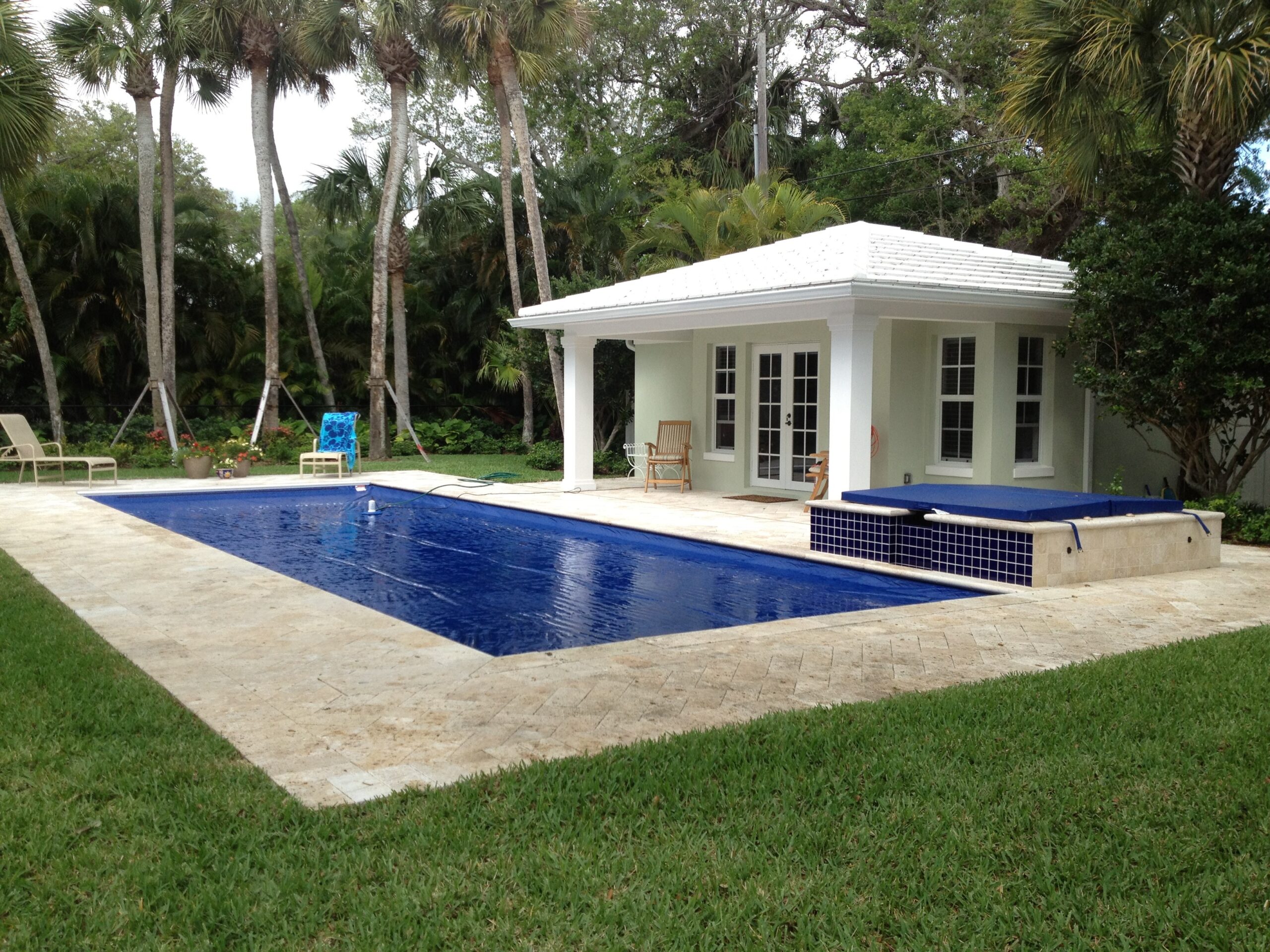
Choosing a pool cover comes down to three questions: how you use your pool, who lives in or visits your home, and how much convenience you want. Most homeowners end up comparing three types: automatic covers, mesh safety covers and solid safety covers. Here is how they stack up for a Florida pool that stays open all year.
The quick answer
- Automatic pool cover: best if you want to cover the pool every day with the turn of a key. It is the most convenient and the most expensive option.
- Mesh safety cover: best if you want a strong safety barrier at a lower cost and don’t mind installing and removing it by hand.
- Solid safety cover: best if you want to block sunlight and debris completely during long stretches when the pool isn’t used, such as while you’re away for a season.
Automatic pool covers
An automatic cover runs on a track along the sides of the pool and opens or closes with a key switch, usually in under a minute. Because it is so easy to use, people actually close it every time they finish swimming, which is where most of its value comes from.
Pros
- Opens and closes in seconds, so it gets used every day instead of sitting in the garage
- Covers that meet the ASTM F1346 safety standard can serve as a pool safety feature under Florida law (more on that below)
- Keeps leaves, palm fronds, sand and bugs out, which means less skimming and vacuuming
- Reduces evaporation, heat loss and chemical use. The U.S. Department of Energy says covering a pool when it isn’t in use can cut heating costs by 50% to 70%, make-up water by 30% to 50% and chemical use by 35% to 60%.
- Can be built into new pools or added to many existing pools, with tracks mounted on the deck, under the coping or recessed out of sight
Cons
- Highest upfront cost of the three types
- Works best on rectangular pools. Freeform pools can often be covered too, but they need custom tracks or design changes.
- Rainwater collects on top and needs to be pumped off, usually with a small cover pump
- The fabric and motor will eventually need service or replacement
Mesh safety covers
A mesh safety cover is a tightly woven fabric that stretches across the pool and anchors into the deck with straps and springs. Installed correctly, it can hold the weight of an adult, a child or a pet.
Pros
- Much lower cost than an automatic cover
- Rain drains through the mesh, so there is usually no standing water to pump off
- Lightweight and easy to store
- Fits nearly any pool shape
Cons
- Has to be installed and removed by hand, which is a two-person job, so most families don’t use it daily
- Lets some sunlight and fine debris through, which can lead to algae and a dirtier pool when you take the cover off
- Needs deck anchors drilled into your pavers or concrete
Solid safety covers
A solid safety cover anchors the same way as a mesh cover, but it is made of a solid vinyl material that blocks water, light and debris.
Pros
- Blocks sunlight, so algae can’t grow while the pool is covered
- Keeps all debris out, so the water is cleaner when you reopen
- Strong safety barrier when installed correctly
Cons
- Heavier and harder to put on and take off than mesh
- Rainwater collects on top and must be pumped off regularly, which matters in Florida’s summer storms
- Best suited to long periods when the pool won’t be used, not everyday covering
Side-by-side comparison
| Automatic | Mesh safety | Solid safety | |
|---|---|---|---|
| Daily convenience | Excellent (key switch) | Low (manual) | Low (manual) |
| Safety barrier | Yes, if ASTM F1346 rated | Yes, if ASTM F1346 rated | Yes, if ASTM F1346 rated |
| Keeps debris out | Yes | Mostly | Yes |
| Blocks sunlight | Yes | Partly | Yes |
| Rainwater | Pump off | Drains through | Pump off |
| Energy and chemical savings | Highest (used daily) | Limited | Limited |
| Upfront cost | Highest | Lowest | Moderate |
What Florida law says about pool covers
Florida’s Residential Swimming Pool Safety Act (Chapter 515, Florida Statutes) requires a new residential pool to have at least one approved safety feature before it can pass final inspection. One of the options is an “approved safety pool cover,” which the law defines as a manual or power-operated cover that meets the ASTM F1346 standard. The other options include a pool barrier, door and window exit alarms, self-closing door latches and an approved in-pool alarm.
That means a certified automatic or manual safety cover can be one way to meet the requirement. Local building departments can add their own rules, so check with your city or county before you rely on a cover alone, and ask your installer to confirm the cover you choose is ASTM F1346 compliant. For more detail, read our guide to Florida pool safety law and pool covers.
Which cover is right for you?
- You have young children, grandchildren or pets: an automatic cover is the safety option you will actually use every day.
- You want lower heating and chemical bills: an automatic cover, because it gets closed every night.
- You want a safety barrier on a budget: a mesh safety cover.
- You leave the pool unused for months at a time: a solid or mesh safety cover, or an automatic cover if you also want everyday use when you’re home.
Get expert advice for your pool
Safety Pool Covers USA sells and installs automatic, semi-automatic and manual safety covers from Loop-Loc, Cover-Dream, Aquamatic and Coverstar. We can look at your pool’s shape, deck and budget and recommend the right fit. Request a free quote or call us at 772-219-8030.


